


In "The Teacher Who Followed," I shared a true story from my early years as a special education teacher—about Spencer, a student whose life was transformed not by any particular intervention or framework, but by the simple, radical act of being deeply known. For four years, I broke convention and followed him from elementary to middle school. This wasn't some grand plan; it was a response to what I saw within my first few weeks of teaching: kids desperately need relationships they can count on, relationships that last over time. When the opportunity arose to move schools with Spencer, I took it. Through that experience, Spencer taught me what belonging truly means—especially for kids who don't fit the standard mold, who don't have the opportunities that wealth provides. He showed me, early in my career, that consistency, predictability, and a sense of place can be everything.
Now, over two decades later, I still teach every day. I still talk to Spencer and many of my former students. My days are spent in classrooms, in IEP meetings, debugging why a student's virtual environment crashed, researching cognitive load theory between parent conferences, and building systems that actually work for the kids who need them most. At Conduit Academy, I am constantly asking: What does the science tell us about why my approach with Spencer worked? What is it about being known, about having a stable environment, about feeling a sense of place that so profoundly impacts learning? I’ve taken these insights, both from research and from my actual and constant teaching experience, and am building them into the very architecture of how we educate.
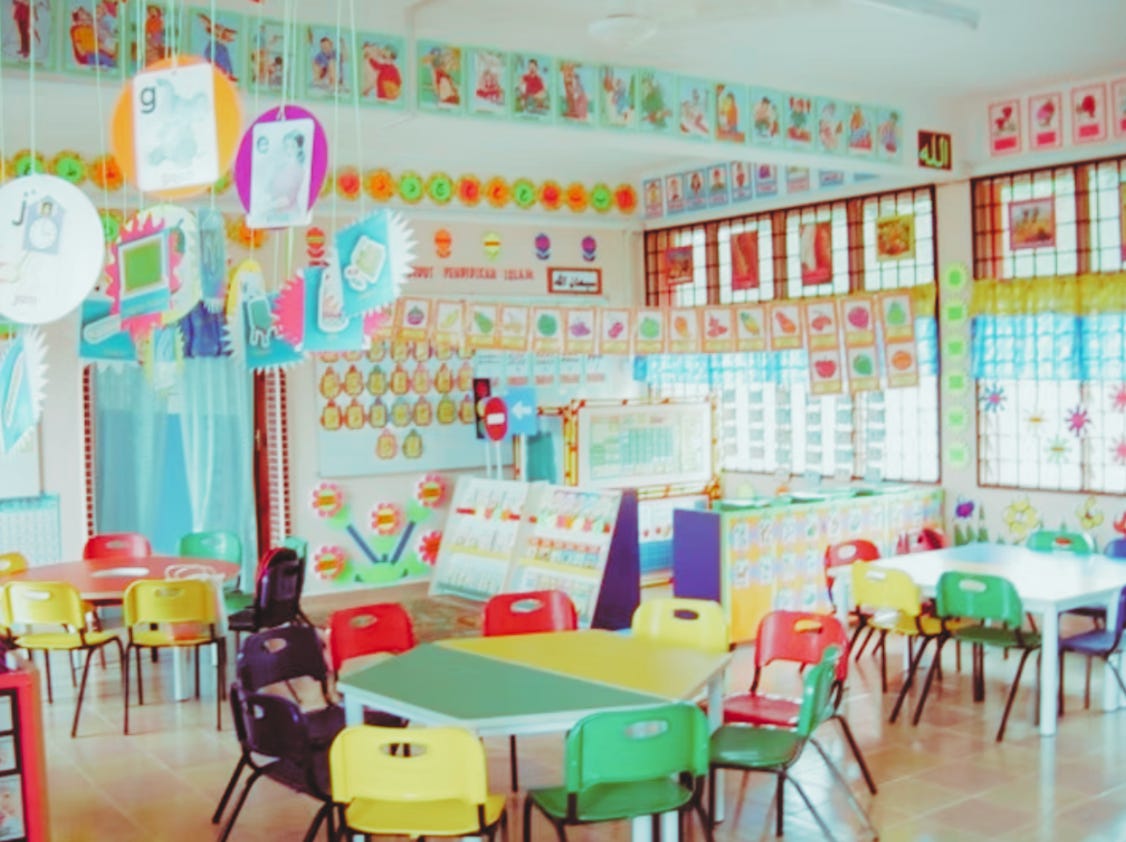
For the past decade, we have largely accepted a flawed premise in online education: that a student is a disembodied head in a box, and a classroom is a grid of faces. This model, born of technological convenience rather than pedagogical wisdom, represents a fundamental misunderstanding of how humans learn. The cognitive challenges it creates are not unique to digital spaces. Research demonstrates that environmental design profoundly impacts learning outcomes across all contexts. A seminal study from Carnegie Mellon University's Anna V. Fisher and colleagues (2014) found that children in heavily decorated classrooms were more distracted, spent significantly more time off-task (38.6% versus 28.4%), and demonstrated smaller learning gains than their peers in more visually sparse environments.¹
The underlying mechanism is consistent across physical and digital domains: environmental complexity creates a state of cognitive overload that actively impedes the learning process.
To understand why, we must examine the architecture of human cognition. Our working memory, the mental workspace where we actively process information, operates under severe constraints. Miller's (1956) classic work established that we can hold only about seven items in working memory at once, though more recent research by Cowan (2010) suggests the true capacity may be closer to four chunks of information.² This limited resource faces constant demands, which cognitive scientists categorize as different types of cognitive load.
John Sweller's Cognitive Load Theory, refined over decades of research, distinguishes between three types of mental burden.³
And just like cholesterol, not all cognitive load is the same.
First, there is extraneous cognitive load: the mental effort expended on elements irrelevant to learning itself. In digital environments, this includes navigating confusing interfaces, managing technical difficulties, or coping with what researchers now term "Zoom fatigue"—the documented phenomenon of exhaustion from videoconferencing that Bailenson (2021) attributes to excessive cognitive demands from constant self-view, limited mobility, and heightened nonverbal overload.⁴
But here's what we rarely acknowledge: physical classrooms carry their own heavy burden of extraneous cognitive load. In my years teaching in traditional settings, I've watched students expend enormous mental energy simply navigating the social complexity of shared space: decoding peer dynamics, managing sensory overload from pen clicking or fidgeting, maintaining focus when a classmate has a meltdown or refuses to work. Every student becomes an involuntary processor of their peers' struggles. When one student disrupts, twenty other minds must work to filter out that disruption. Learning doesn't just pause; it often stops entirely. The irony is that well-designed online environments can eliminate many of these cognitive drains that we've simply accepted as inevitable in physical classrooms. A student struggling with an assignment online doesn't derail their classmates' focus. The anxious pen-clicker doesn't exist in their soundscape. The constant work of "figuring out our peers"- reading social cues, managing interpersonal dynamics, navigating classroom politics - can be dramatically reduced, freeing cognitive resources for actual learning.
In contrast, germane cognitive load represents the productive mental effort of schema construction: deep thinking required to build lasting understanding. This is the cognitive work of connecting new concepts to existing knowledge structures, solving complex problems, and developing expertise. Recent neuroscience research by Immordino-Yang and colleagues (2019) demonstrates that this type of effortful thinking, when properly supported, leads to more robust neural networks and deeper learning.⁵
A fundamental responsibility for all educators, therefore, is to function as what I call a "cognitive architect" - deliberately designing learning environments that minimize extraneous load while maximizing opportunities for germane cognitive processing.
At Conduit Academy, we are translating this principle into a comprehensive environmental design philosophy.
Our approach begins by addressing the phenomenon of digital placelessness—the psychological rootlessness that characterizes most online learning. Research on place attachment by Scannell and Gifford (2017) reveals that meaningful connections to spaces, whether physical or virtual, reduce stress and enhance well-being.⁶ When students begin their independent work at Conduit Academy, they don't merely open browser tabs; they actively "arrive" in a personalized virtual office. This transition is marked by sensory cues - a chosen song, familiar visual elements - that trigger what environmental psychologists call "restorative experiences."
The personal office features virtual shelves displaying student-selected images, videos, and meaningful learning artifacts. This isn't mere decoration; it represents the application of Self-Determination Theory (Ryan & Deci, 2020), which demonstrates that autonomy and personalization enhance intrinsic motivation and engagement.⁷ The ritualized arrival process serves a crucial cognitive function: it signals a contextual shift that prepares the mind for focused work, similar to how physical transitions between spaces can enhance task performance.
Crucially, this personalized space exists within a persistent virtual world that addresses the isolation inherent in asynchronous online learning. While students remain off-camera by default - eliminating the documented stressors of constant video presence - they maintain representation through avatars in a shared digital environment. This design leverages research on "social presence theory" by Biocca and colleagues (2003), which demonstrates that even minimal social cues in virtual environments can create meaningful feelings of co-presence and community.⁸
The environment facilitates what we might call "ambient sociality"—low-threshold interactions that maintain social bonds without demanding significant cognitive resources. Students can exchange virtual fist-bumps accompanied by satisfying haptic feedback, share contextual emojis, or engage in brief collaborative games. These features draw on research by Ducheneaut and Moore (2004) showing that lightweight social interactions in virtual spaces can build genuine community while preserving individual focus capacity.⁹
Each design element - the personalized arrival ritual, the persistent spatial metaphor, the calibrated social presence - serves a deliberate cognitive purpose. By creating environmental stability and reducing the mental overhead of simply existing in the learning space, we liberate cognitive resources for their intended purpose: deep learning.
This approach represents a fundamental reimagining of online education's possibilities. Rather than accepting the limitations of video-grid classrooms and isolated asynchronous work, we can architect digital environments that honor both human psychology and the demands of rigorous learning. By addressing the crisis of digital placelessness, we create not just virtual spaces, but genuine places, places that are cognitively optimized environments where the difficult, essential work of education can flourish.
References:
Fisher, A. V., Godwin, K. E., & Seltman, H. (2014). Visual environment, attention allocation, and learning in young children: When too much of a good thing may be bad. Psychological Science, 25(7), 1362-1370.
Cowan, N. (2010). The magical mystery four: How is working memory capacity limited, and why? Current Directions in Psychological Science, 19(1), 51-57.
Sweller, J., van Merriënboer, J. J. G., & Paas, F. (2019). Cognitive architecture and instructional design: 20 years later. Educational Psychology Review, 31(2), 261-292.
Bailenson, J. N. (2021). Nonverbal overload: A theoretical argument for the causes of Zoom fatigue. Technology, Mind, and Behavior, 2(1).
Immordino-Yang, M. H., Darling-Hammond, L., & Krone, C. R. (2019). Nurturing nature: How brain development is inherently social and emotional, and what this means for education. Educational Psychologist, 54(3), 185-204.
Scannell, L., & Gifford, R. (2017). The experienced psychological benefits of place attachment. Journal of Environmental Psychology, 51, 256-269.
Ryan, R. M., & Deci, E. L. (2020). Intrinsic and extrinsic motivation from a self-determination theory perspective: Definitions, theory, practices, and future directions. Contemporary Educational Psychology, 61, 101860.
Biocca, F., Harms, C., & Burgoon, J. K. (2003). Toward a more robust theory and measure of social presence: Review and suggested criteria. Presence: Teleoperators and Virtual Environments, 12(5), 456-480.
Ducheneaut, N., & Moore, R. J. (2004). The social side of gaming: A study of interaction patterns in a massively multiplayer online game. Proceedings of the 2004 ACM Conference on Computer Supported Cooperative Work, 360-369.