


This week I read Julie Pottinger’s Rethinking the Order of Operations, and I haven’t stopped thinking about it. Her argument is that teaching PEMDAS creates the very errors it’s meant to prevent. Kids learn “A before S” and “M before D,” forget the “left to right” part, and confidently add before they subtract. She wants us to teach the structure of expressions instead.
She also writes that we read and write from left to right, so students who were never taught the order of operations might simplify expressions correctly anyway. As a linguist, that line sent me straight to Persian.
Persian runs right to left. But in Persian, numbers and mathematical expressions are written left to right, inside text that runs right to left (W3C; Persian orthography notes). The direction flips in the middle of the page as soon as an expression starts. So Persian-reading kids aren’t carrying a reading habit into math. They’re learning math’s direction as a separate convention, almost like a second script.
My husband is Persian, and I talk about this with him, his family and our friends all the time. One thing they always bring up is how much Persian kids play with math in the early grades. That matters here. Play is where children get to push numbers around, regroup them and see what stays the same before anyone hands them a rule. It’s how they absorb a structure instead of memorizing a procedure, the same way young readers absorb sentence structure through rhymes, songs and stories long before anyone names a clause.
I don’t think that undercuts Pottinger. I think it points to the strongest part of her argument. Math isn’t an extension of the language around it. It has its own grammar. And we already know how to teach grammar, because that’s what we do in reading.
What a grammar actually is
A grammar tells you what goes with what. Linguists call this constituency: which pieces belong together, and how small units build into bigger ones.
In English, the prefix un- belongs to happy. “Three bags of four” is a single noun phrase, even though it holds several words. A subordinate clause works as one unit inside a larger sentence. Readers who can see that structure understand what they read. Readers who can’t are just stringing words together.
Math works the same way. A sign belongs to the number after it, so in 10 − 3 + 4 the minus belongs to the 3. The expression is three signed terms: +10, −3 and +4. Plus and minus mark where terms begin and end. Times and divide bind numbers together inside a term. Parentheses take a whole expression and make it act as one term in a bigger one.
Look at 20 − 3 × 4 through that lens. It has two terms: +20 and −(3 × 4). The 3 × 4 is one chunk, like “three bags of four.” You don’t need a rule that says “multiply first.” You can see that 3 × 4 is a single unit, and the order falls out of the structure.
Most “math is a language” teaching stops at vocabulary. Kids learn that product means multiply and difference means subtract. Then they practice translating word problems into symbols. That’s useful, but it’s vocabulary and translation. Very few of us teach the grammar itself.
Some languages teach the grammar for free
The grammar of math starts before kids ever see an expression. It’s already in the number words they speak, and believe it or not, some languages make it much easier to see than others.
Travel from east to west and you can actually watch place value get harder to hear. In Chinese, 11 is “ten-one,” 12 is “ten-two,” and 23 is “two-ten-three.” The number word is the place-value structure (mandarintools). A child who can count to 99 has heard tens and ones spelled out hundreds of times.
English hides all of that. Eleven and twelve give no hint of ten-and-one or ten-and-two. The teens flip the order, so seventeen names the ones before the ten, while twenty-seven names the ten first. Twenty, thirty and fifty only loosely sound like two, three and five. English-speaking children have to work out the base-ten system behind words that keep covering it up.
And it doesn’t stop there. In French, 97 is quatre-vingt-dix-sept: four twenties, plus ten, plus seven. German says 27 as siebenundzwanzig, “seven-and-twenty,” with the ones first.
This isn’t just a theory. In a 1995 study, Kevin Miller and colleagues compared preschoolers in the US and China. The Chinese children’s advantage showed up early and was specific to counting: English-speaking children had more trouble learning to count through the teens. On other early math tasks, like counting small sets, the two groups did about the same. That’s not a difference in ability. It’s a difference in how transparent the grammar of their number words is. When the language does the work, kids get number sense almost for free. When it doesn’t, we have to teach the structure explicitly, which is exactly the point of this whole piece.
Chinese schools also start multiplication earlier. The multiplication tables are Grade 2 material in all three major Chinese textbook series, compared with Grade 3 in the US. Children learn the nine-nine table as a spoken rhyme, and it’s built from the same transparent number words. Three times four is sān sì shí èr: “three four, ten two.” The answer arrives already broken into tens and ones.
Reading grammar and math grammar, side by side
Reading and math line up level by level, from the smallest unit all the way to meaning.
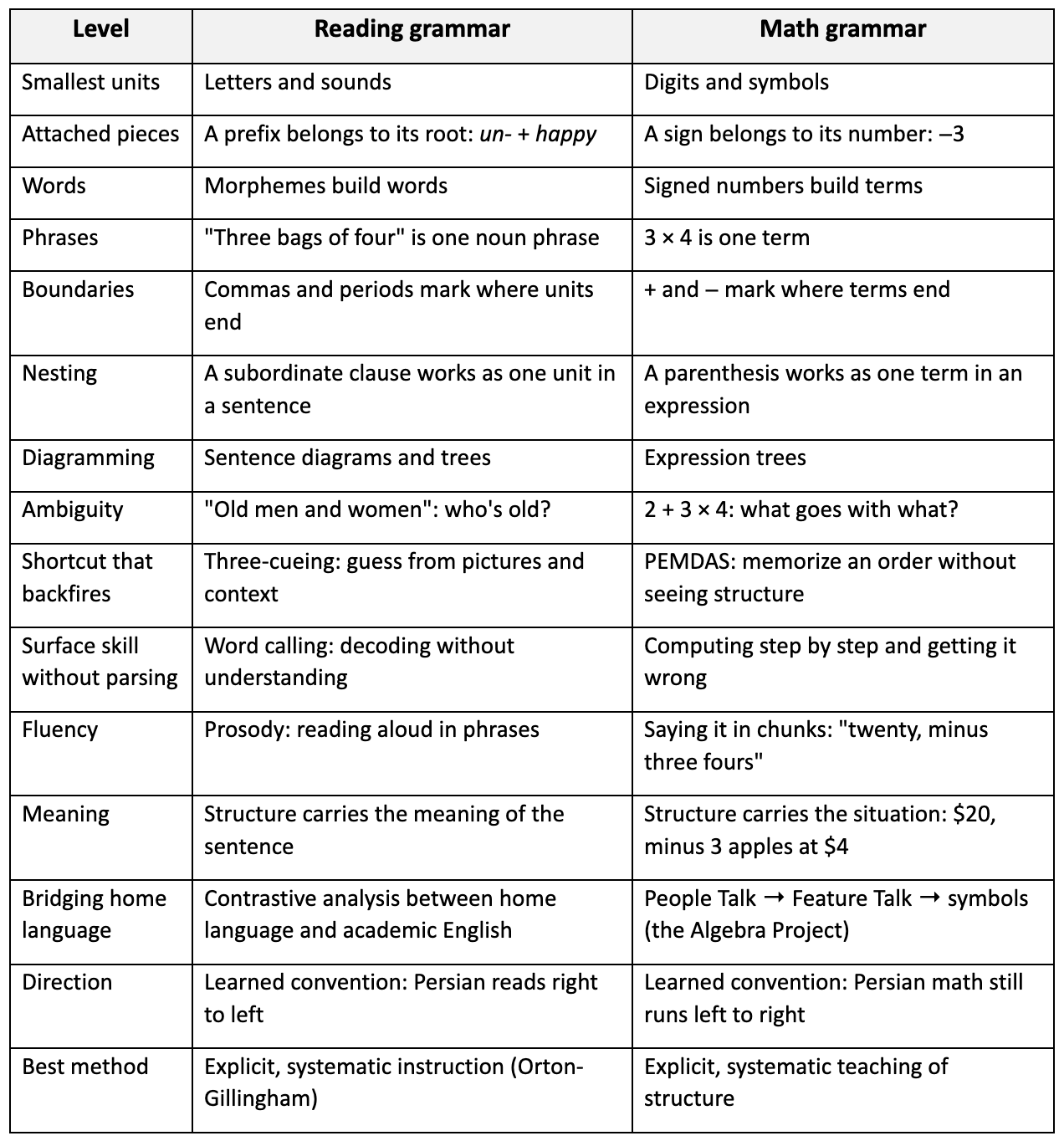
The shortcuts that backfire
The row in that table that matters most to me is the shortcut row.
In reading, some spent decades teaching three-cueing. A child who got stuck on a word was told to look at the picture, think about what would make sense, and guess. It worked for a while. Kids looked like readers. Then the books got harder, the pictures went away, and the guessing fell apart. The children who struggled most were the ones who had never been taught to look at the structure of the word itself.
PEMDAS does the same thing in math. It gives kids a sequence to memorize instead of a structure to see. It works for a while, and kids look like they understand. Then they meet 10 − 3 + 4, or a fraction bar, or a nested parenthesis, and the mnemonic breaks. They add before they subtract because the letters told them to.
Both shortcuts fail for the same reason. They let a child perform without parsing. The fix is the same too. Teach what attaches to what, explicitly and systematically, until the student can see the structure on their own.
For children with learning differences, this matters even more. A memorized sequence with hidden exceptions is exactly the kind of thing that slips away under load. A structure you can see, draw and say out loud is something you can hold onto.
Starting from the language kids already have
Early in my career I taught reading to children who spoke African American English at home. What worked was contrastive analysis: putting the child’s home grammar next to academic English and naming the differences out loud. Their language was never the problem - it was never NOT rule driven. It was a full grammar, and once we could see both systems side by side, kids could move between them on purpose.
Bob Moses built something very close to this for math. The Algebra Project uses a five-step process. Students start with a shared physical experience, draw a picture or model of it, and describe it in their own words, which Moses called People Talk. Then they move to Feature Talk, a more regimented language that pins down the mathematical relationships. Only after that do they write it in symbols.
Feature Talk is the piece I keep coming back to. It’s a bridge grammar, sitting between the way kids actually talk and formal notation. That’s contrastive analysis for math. It treats the child’s language as the foundation, not the obstacle, and it makes the rules of the new system visible instead of assumed.
The Algebra Project has been doing this work for more than four decades. One of its most recent efforts, the Accessible Calculus Project, ran from September 2023 to September 2026 and brought calculus ideas into high school Algebra II. If you want to see what teaching math as a language looks like you might start here.
What this could look like in a classroom
If we taught math grammar the way good reading teachers teach reading grammar, a few things would change.
Teach signs as part of the term. Have students rewrite 10 − 3 + 4 as +10, −3, +4 and add them in any order. Once they see that the answer doesn’t change, “add before subtract” stops making sense to them.
Chunk expressions into terms before computing. Ask “how many terms are there?” before “what’s the answer?” Have kids circle each term, the way we have them scoop phrases when they read.
Say it in phrases. Read 20 − 3 × 4 aloud as “twenty, minus three fours.” Prosody does for math what it does for reading: it shows the reader where the units are.
Diagram expressions as trees. Students who have diagrammed sentences will recognize this right away. Parentheses become branches, not a rule to apply first.
Play with ambiguity on purpose. Put “old men and women” next to 2 + 3 × 4 and ask what each could mean. Then show how the grammar settles it.
Start from the child’s own words. Begin with a real situation, let students describe it in their own language, then tighten that language toward the notation. That’s the Algebra Project’s sequence, and it works. (We also use this at Conduit Academy.)
None of this throws out explicit instruction. It’s explicit instruction aimed at the right thing. We stop drilling a sequence and start teaching a structure.
But isn’t play just “discovery”?
Anyone who live(d)(ing) through the reading wars will sadly now flinch at the word play. And that is so unfortunate because play is not the problem.
The research the reading world leans on is mostly about unguided learning. Kirschner, Sweller and Clark’s well-known 2006 paper reviewed decades of studies and found that minimally guided instruction is less effective than instruction with strong guidance. But the same paper notes an important exception: the advantage of guidance shrinks once learners have enough prior knowledge to guide themselves.
The math play I’m describing isn’t unguided. Chinese and Persian children play inside a structure they’ve already been given: transparent number words and chanted times tables. They’re exploring a grammar, not inventing one. Researchers call this guided play: an adult sets the learning goal, and children are steered to explore toward it. A meta-analysis comparing explicit instruction, unassisted discovery and assisted discovery found the best outcomes for assisted discovery. Guessing at a word from a picture is unguided discovery. Playing with a structure you’ve been taught is guided play.
Each country reaching for what the other has
In 2016 I traveled to China with the College Board. I saw Chinese officials working with American school administrators to make school more fun and more open to discovery. That wasn’t a one-off. Chinese policymakers had been pushing “quality education”, asking teachers to spark original thinking, encourage questioning and make room for students’ interests. That same year, a China Daily column described growing criticism in China that test-driven schooling kills children’s creativity, even as some American schools were looking to China for answers.
I think the key is order. China already had the explicit foundation and wanted to add exploration on top of it. That’s exactly when, by Kirschner’s own account, guidance can start to ease off. In the US, we often tried discovery first, before children had the structure. Each country was reaching for what the other already had. Neither one alone is the answer. Structure first, then play, then more structure, is.
A grammar, not a recipe
Reading research spent years showing us that guessing isn’t reading. I think math is due for the same reckoning. PEMDAS is a recipe: do this, then this, then this. A grammar is different. It tells you what the pieces are and how they fit, and once you can see that, you don’t need the recipe.
Pottinger is onto something important. The Persian puzzle doesn’t weaken her case. It shows that math’s direction, like its structure, is something we learn as its own system. If that’s true, we should teach it as its own system, with the same care we give reading.
I’d love to hear from other teachers. Have you taught math this way? Have you worked with students who read a right-to-left language? What did you see?
Sources
Julie Pottinger, Rethinking the Order of Operations
W3C, Arabic mathematical notation; Persian orthography notes
Miller, Smith, Zhu & Zhang (1995), Preschool Origins of Cross-National Differences in Mathematical Competence, Psychological Science
Chinese number words; French numbers 60–100; French and German numbers
APM Reports, What’s wrong with how schools teach reading
The Algebra Project’s five-step process; The Three Pillars; Cohorts and Communities in the Algebra Project, CMS Notes
There’s one question that has been bugging me for years, and I’m wondering if you can address it from the linguist’s perspective. In the U.S., we usually teach the order of operations in 5th grade. So would this approach (which I absolutely love, by the way) change how we teach addition and subtraction in younger grades? Kids learn that addition is commutative, but that subtraction is not. As they’re learning their math facts in early grades, they learn that 3+5 is equal to 5+3, but that 3-5 does not equal 5-3. From a terms approach, this absolutely makes sense. But I’d argue that 2nd and 3rd graders are mostly too young to understand “terms” -- to them, that minus sign is the operator, not a sign that goes with the number after it (and this is how we teach it all the way through when we introduce negative numbers in 6th grade -- and suddenly there’s confusion). I’ve heard, but not researched, that in some other countries there is only one word for minus and negative, which might eliminate some of the confusion. So I’m really interested in thinking about how we could take Pottinger’s terms approach and back it up into younger grades in a developmentally appropriate way, and then extending it out into later grades and looking at the consequences. I’d love to hear your thoughts on this.
The very pure place value spoken numbers in the chinese languages would surely help early number learning. But there is another aspect I have thought about.
Beyond that very early stage maths is a written language, with symbols arranged in a two dimensional space. Expressions are nothing like phonetic transcriptions of a spoken version of them.
Do you think that learning a written language that is not phonetic, and where the meaning is often related to the combinations of graphical elements, makes mathematics in general easier to learn? Add to that learning to read classics in middle school, I understand that the classical chinese is further from the spoken language and a more purely written form than the modern forms.