


Show ready
In 2001, I started teaching at Weinland Park Elementary in Columbus, Ohio. The school used Direct Instruction. The school is overwhelmingly Black. More info on its demographics is here.
The first thing we had to teach our students was to be in position for learning. And that position had a name - it was called “show ready.” Hands folded. Feet on the floor. Eyes on the teacher. Mouth closed. In the official training, “show your ready” is how a DI lesson begins, so that every child can answer on the teacher’s signal.
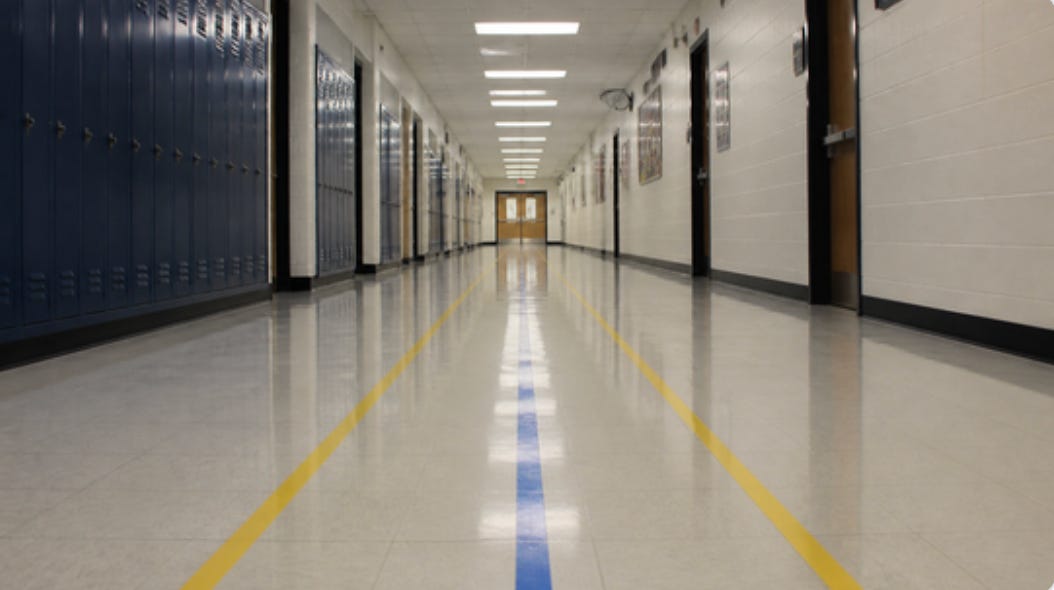
At Weinland Park, show ready wasn’t just for instruction or during learning time. Children held show ready in line, in the hallway, at lunch, on the way to the bathroom. In the halls they walked single file with their hands behind their backs. Everywhere they went, their bodies were supposed to be still and silent.
Children regardless of age or neurodiversity or any other factor (did you eat breakfast that day) were expected to be in “show ready” at all times. And they were punished if they were not.
Among the teachers, we had another name for it. We called it “jail ready.” And it was accurate - hands behind your back, eyes forward, no talking, single file. That’s how you move prisoners. (We also had a convicted felon who was a parent volunteer and when we complained were told, “everyone deserves a second chance” - he served time in prison for aggravate assault as part of the Short North Posse gang…but I digress…)
Recess
If the line wasn’t in show ready, the line didn’t go to recess. And on a lot of days, that meant the whole school didn’t go. Can you imagine standing in line waiting for a recess that never comes?
Some of my students could not control their bodies. Some had ADHD. Some had motor or sensory differences no one had named yet. I had one student who I still talk to today who simply could not hold that position for more than a minute before he would forget what he was doing and then ruin it for the entire school!
On many days, those children were the reason no one else got to play. Sure, they went outside but instead of playing, they stood in a line the entire recess - waiting for the whole K-5 school of about 300 kids to be in “show ready” long enough to satisfy the principal - and they too rarely held it long enough.
What did that teach them? The kid who couldn’t sit still learned that his body was the problem. The other kids learned to blame him. And everybody lost the one thing that would have helped him sit still later - time to run around.
I wrote my master’s thesis on movement and teaching. But I didn’t need it to know what happens when seven-year-olds don’t get to run. Any teacher who has spent a morning with them knows. We took recess away from the kids who needed it most.
The other school
Then I went to work at Cassingham Elementary in Bexley. If you live in Columbus, you know Bexley isn’t really a different city - it’s a small, wealthy enclave completely surrounded by Columbus, with its own school district so its tax dollars stay with its own kids. The school is overwhelmingly white. More info on its demographics is here.
Those kids skipped down the hall. They talked in line, touched the walls, bumped into each other, and laughed. Nobody had their hands behind their backs. Nobody lost recess because a classmate couldn’t sit still. I can’t remember one day when the whole school missed recess.
And they were learning - a lot of them were doing really well. Nobody thought they had to be still and silent to learn.
The difference was jarring and upsetting, and honestly it still is. Same ages, same city - just on opposite sides of a school district line. Completely different rules about what a kid’s body was allowed to do.
Who was trusted
The Black children were not trusted. The white children were.
This wasn’t about learning. If kids had to be still and silent to learn, the wealthy school would have made them do it too. It didn’t - and those kids read just fine.
At Weinland Park, everything was built on the idea that if a Black child moved for even a minute, there would be trouble. So they were never allowed to move. At the other school, nobody worried about that. The white kids were allowed to just be kids.
Kids learn what we expect of them. One group learned they were trusted. The other learned they were always being watched - and they practiced the posture of being under arrest every single day.
Who got books
And then there were the books.
My students at Weinland Park read from Reading Mastery. Scripted lessons, program readers, choral responses on the signal. No child got books. We had a school library, but the children were not allowed to check books out, because they were not trusted to take them home. They didn’t read actual books, start to finish. Not until I refused to keep teaching DI. Then I taught them real books. We read Harry Potter together, and my students were thrilled to be introduced to this new world. They learned to love books. They also passed the tests. My second year as a teacher (NOT using DI - using my own training as a linguist), three of my four fourth graders passed the state writing test, far above the school’s average, and each of them had an IEP. My students learned to read and write. Trusting them did not cost them achievement.
What I learned is that children will respond to almost any book if the teacher loves the book and the children love their teacher. Reading grows out of relationships. My students didn’t learn better from special books someone else picked out for them. They learned better because they had someone who trusted them with the whole library.
The kids at Cassingham ES never did DI. They read whole books, picked their own books, and argued about them. They had library time and checked out books. They were trusted with books the same way they were trusted with their bodies.
I have spent more than 25 years teaching reading, much of it to children with learning differences. I am Orton-Gillingham trained. I hold a degrees in linguistics and special education, and I have presented at NWAV, the field’s major sociolinguistics conference, with John Rickford, H. Samy Alim, and John Baugh on Black language and special education, particularly in reading. But what I know best, I learned with children in front of me. I still teach reading every week, and I run a school for children with learning differences. I believe in explicit, systematic instruction in how words work. Decoding has to be taught, and children need it taught directly.
But decoding isn’t the goal - reading is. A kid can learn to sound out every word on a worksheet and still learn that reading is something done to them, sitting in show ready, with no book of their own. That kid might pass the test. But they probably won’t love reading. And kids who don’t love reading stop reading the second nobody’s making them.
What Sold a Story is missing
The second season of Sold a Story asks what happened to teaching. Its answer is Direct Instruction: decades of evidence, and an education establishment that refused to listen.
Episode 4 tells the story of Wesley Elementary in Houston, where principal Thaddeus Lott turned a struggling school around with DI. It’s a powerful story. But it leaves something out.
In 1999, the Christian Science Monitor reported that one of the first skills taught at Wesley was how to walk in line: arms folded, no talking, eyes ahead. A Hoover Institution profile said the same, and praised Lott for placing only 3% of Wesley students in special education, against 10% across Houston. I read that number and I think of my students. Where did the children go whose bodies couldn’t hold the line?
The arguments about Season 2 so far are about data: whether Project Follow Through proved what DI supporters say it proved. That’s a fair debate. But thus far, I have not seen anyone ask about how this program was implemented - at what cost to relationships and learning beyond the script? Where I taught, DI didn’t show up as just a set of reading scripts. It showed up as a whole system for controlling children - and from my experience, this kind of control was only for Black children.
Two stops on the same tour
In May 2000, President Clinton made a two-day School Reform Tour to celebrate schools that had turned themselves around.
His first stop was Audubon Elementary in Owensboro, Kentucky. Two-thirds of its students lived in poverty. About 13% were Black; most were white. Clinton sat with fourth graders and read Charlotte’s Web, stopping to talk through words like “exertion” and “bewilderment.”
His last stop was a Columbus elementary school where the principal told him, with pride, that the school used Direct Instruction and spent 180 minutes a day on reading. Every student wore a uniform. The school is overwhelmingly Black. More info on its demographics is here.
Not long after, the principal who welcomed the President that day came to run my school.
Both schools were poor. Both raised their scores. Both were held up by a President as proof of what works. At one, poor white children read a novel with the President. At the other, poor Black children were praised for three hours a day of scripts and being in control.
That’s what I saw. It wasn’t about rich and poor. It was about who got trusted.
The question
So I want to ask a different question.
Not only “Does DI work?” but “Work for what? For whom? And what did it cost them?” A program can raise reading scores and still teach a child that school is a place where they’re watched, not trusted, and made jail ready. A program can teach decoding and never once hand a child a book.
The white children I taught were trusted with their bodies and trusted with stories. The Black children I taught were trusted with neither. If we’re really asking what happened to teaching, that has to be part of the story.
Thank you for this. What makes it so powerful is that you’re trained in explicit instruction and you believe decoding has to be taught directly. So this isn’t an argument against teaching kids how words work. It’s a question about everything else that came with it.
It makes me think about a school’s mission. Is it to pass the test, or for children to flourish? It can be both. Your students passed the tests and fell in love with Harry Potter. But when passing the test becomes the whole mission, it’s easy to lose sight of what else children are learning, like whether school is a place where they’re trusted or watched.
I also wish the conversation focused less on capital-D Direct Instruction and more on the elements of explicit instruction that help kids. In my consulting work, I’m in schools with teachers who have been teaching for 20 years or more. If those schools brought in DI as a whole program, I believe many of those teachers would leave. Studying direction instruction together, and trusting teachers to use them well, keeps both the kids and the teachers.
Your questions: “Work for what? For whom? And what did it cost them?” are also questions I keep wishing the Sold a Story conversation would ask.
I also experienced this, teaching at a predominantly Black public middle school in Las Vegas. Students were not trusted to pick the color of an undershirt, let alone walk down a hallway.