


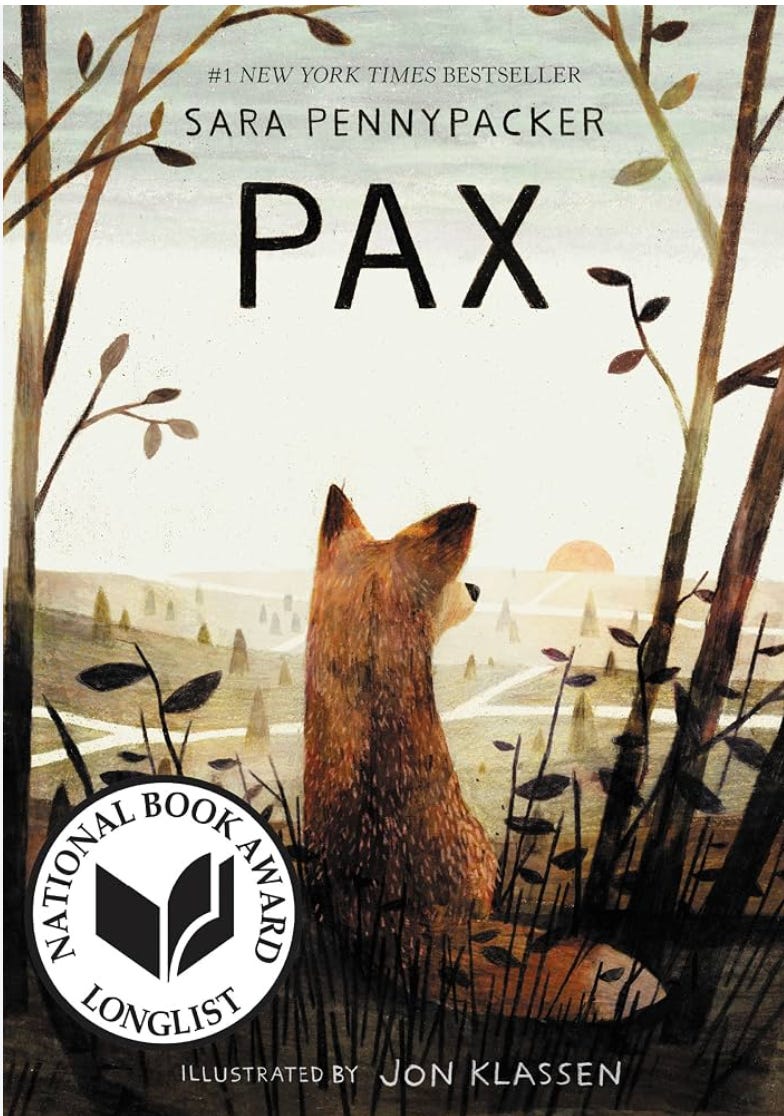
Today something really phenomenal happened. We have been reading the book, “Pax” by Sara Pennypacker. It is the story of a boy named Peter and a fox named Pax. Pennypacker masterfully alternates chapters - one told from Peter’s point of view, the next told from Pax’s point of view, then back to Peter, and so on and so on.
We started this book at the beginning of September. It is nearly 300 pages long which is a lot for my students to eat so we broke it into bite sized delicious pieces.
Alongside this book, we have also been reading parts of a nonfiction book called, “Immense World” by Ed Yong (the junior version). We read about the very different ways other animals are experiencing life on earth and what each creature’s umwelt is. My students have been fascinated and love trying to take the perspective of animals that can see colors that we don’t even know exist!
In this work, my students are writing - you guessed it - animal stories! And they truly and dearly love their stories. I tried something new this go around at storytelling teaching which I always find challenging. I used work from “The Science of Storytelling” by Will Storr and “Story Genius” by Lisa Cron. I have been teaching story writing for years, and I am never fully satisfied with my teaching here. The listing of plot events, the abrupt endings…I wanted to see if I could improve my teaching in this area.
And while the verdict is still out about the storytelling work as we are putting the final touches on our stories this week, the amazing thing that happened today has to do with all this…all this time and love we have been putting into our reading and writing…working on vocabulary, the use of quotation marks, adding appositives, reading out loud fluently…we have put a lot of time into this.
Today, we were going to read chapters 28 and 29 of “Pax” at the end of the school day, saving the final chapters for tomorrow. We started reading out loud with about 20 minutes left in the day.
With about two minutes left in our school time together, we finished reading chapter 29. For those of you who have not read “Pax” yet, chapter 29 ends on kind of a cliffhanger. So I ended the chapter and said, “Okay kids, we will save the rest for tomorrow.” To which they replied something along the lines of “No! No! No! We MUST know what happens - keep reading!!!”
I said, “You want me to keep reading even though I won’t finish until after the end of school which means you will have to stay longer today. Are you okay with that?”
”Yes, yes yes! Just keep reading!!!”
So I did.
We finished the book about ten minutes after we typically dismiss. We didn’t discuss it yet so I am not entirely sure what the students think about the ending as it leaves the reader…or at least me…a bit unsatisfied at the end. Not a lot. But a smidge.
Which is why my students immediately wanted to know if the sequel is out yet.
Kids will love to read if we love to read. When we deconstruct reading immediately into its pieces and parts without visibly connecting those pieces and parts to amazing literature, kids quickly decide that reading is a laborious task that provides minimal benefits. Who wants to read almost 300 pages to find out what happens?
My students and I work online together. They are at their homes with access to their pets, as many snacks as they want, their phones, and obviously, their computers. In other words, there is a lot to compete with for their attention in this setting. As well, I have very little control to “make them” pay attention - I can’t remove their phones, for example or stop them from having their kitty in the chair with them. I can’t control their every movement.
So I have to connect with them. And it turns out the best way I know to do that is exactly what Sara Pennypacker did to us today: make them care what happens next.
Which brings me back to those animal stories. All fall, I have been trying to teach my students what Storr and Cron write about. A story isn’t a list of things that happen. It’s a character who wants something badly, and a reader who needs to find out whether they get it.
And then today, ten minutes past dismissal, my students were still there. Every one of them was at home with a phone within reach, a snack within reach, and quite possibly a cat on their lap. And they stayed.
Not because I made them.
Because they had to know.