


Before a single slide is presented or a word of a lecture is spoken, a profound lesson has already been taught. The very choice of a virtual learning platform—be it Zoom, Google Meet, Microsoft Teams, or the spatial platform Roam—embeds a "hidden curriculum" that shapes learners' understanding of knowledge, collaboration, and the nature of learning itself. This is the central thesis of media theorist Marshall McLuhan, who famously declared, "the medium is the message." McLuhan argued that the characteristics of a technology have a greater and more lasting impact than the content it delivers. Often, this platform "choice" is not a choice at all, but a passive acceptance of the most convenient or embedded option. This article argues that platform selection is a critical pedagogical decision, backed by foundational research in media theory and learning science, that teaches implicit lessons before any formal instruction begins.
Platform Affordances Shape Behavior
To understand how platforms teach, we must turn to the psychologist James J. Gibson, who developed the concept of "affordances." Gibson defined affordances as the possibilities for action that an environment offers an individual. A chair affords sitting; a button affords pushing. In the digital world, the user interface—its buttons, layouts, and features—provides affordances that suggest, guide, and constrain our behavior. These design choices are not neutral; they are the primary mechanism of the hidden curriculum.
Google Meet and the Curriculum of Convenience
Google Meet represents the path of least resistance in educational technology. Its primary affordance is not a pedagogical feature, but its seamless integration into the Google Workspace ecosystem. In the language of Gibson's theory, it affords convenience above all else. This convenience, however, comes at a pedagogical cost. Its interface is generic, and its interactions are intentionally ephemeral—the chat, a crucial channel for student participation, vanishes the moment the call ends.
The implicit curriculum of Google Meet is one of transience and interchangeability. It teaches that the learning space is a disposable utility, a generic container with no inherent value or persistence. By being the default, it encourages a passive acceptance that Neil Postman warned of in his seminal work, Technopoly. Postman argued that a technopoly is a culture that surrenders its judgment to the perceived efficiencies of technology. Choosing Meet simply because it's "there" is a small-scale example of this surrender, implicitly teaching that the environment for learning is inconsequential.
How Zoom's "Presenter/Audience" Model Reinforces Traditional Hierarchies
Zoom offers a slightly more robust feature set, yet its core affordances still reinforce a traditional, hierarchical model of knowledge transmission. Features like "Spotlight" and the default speaker view place visual emphasis on one person, creating a clear distinction between the expert presenter and the passive audience. This design implicitly teaches that learning is a scheduled event, a performance, rather than a continuous, collaborative process.
Teams' Corporate Aesthetic Signals "Work" vs. "Learning"
Microsoft Teams, born from the corporate world, offers affordances for productivity and project management. Persistent channels, file integration, and task management create an environment optimized for structured, goal-oriented collaboration. However, as researcher danah boyd has shown, users are highly adept at reading the social context of a platform and adjusting their behavior accordingly. The corporate aesthetic of Teams signals a context of "work" and "production," which can subtly shift the focus from open-ended intellectual exploration to the efficient completion of deliverables, framing learning as a form of managed labor.
Roam's Spatial Persistence Suggests Knowledge is a Place to Be Built
In stark contrast, Roam is an immersive platform whose fundamental affordance is spatial presence. Users, represented by avatars, inhabit a persistent, customizable 2D world. This spatial design affords organic and emergent social interaction, mimicking the natural dynamics of a physical campus where multiple conversations can happen at once. The environment itself is a shared, persistent artifact. This teaches a powerful lesson: knowledge is not just information to be transferred, but a space to be inhabited, explored, and constructed together. The implicit curriculum of Roam is that learning is experiential, emergent, and deeply social, fostering a tangible sense of community presence.
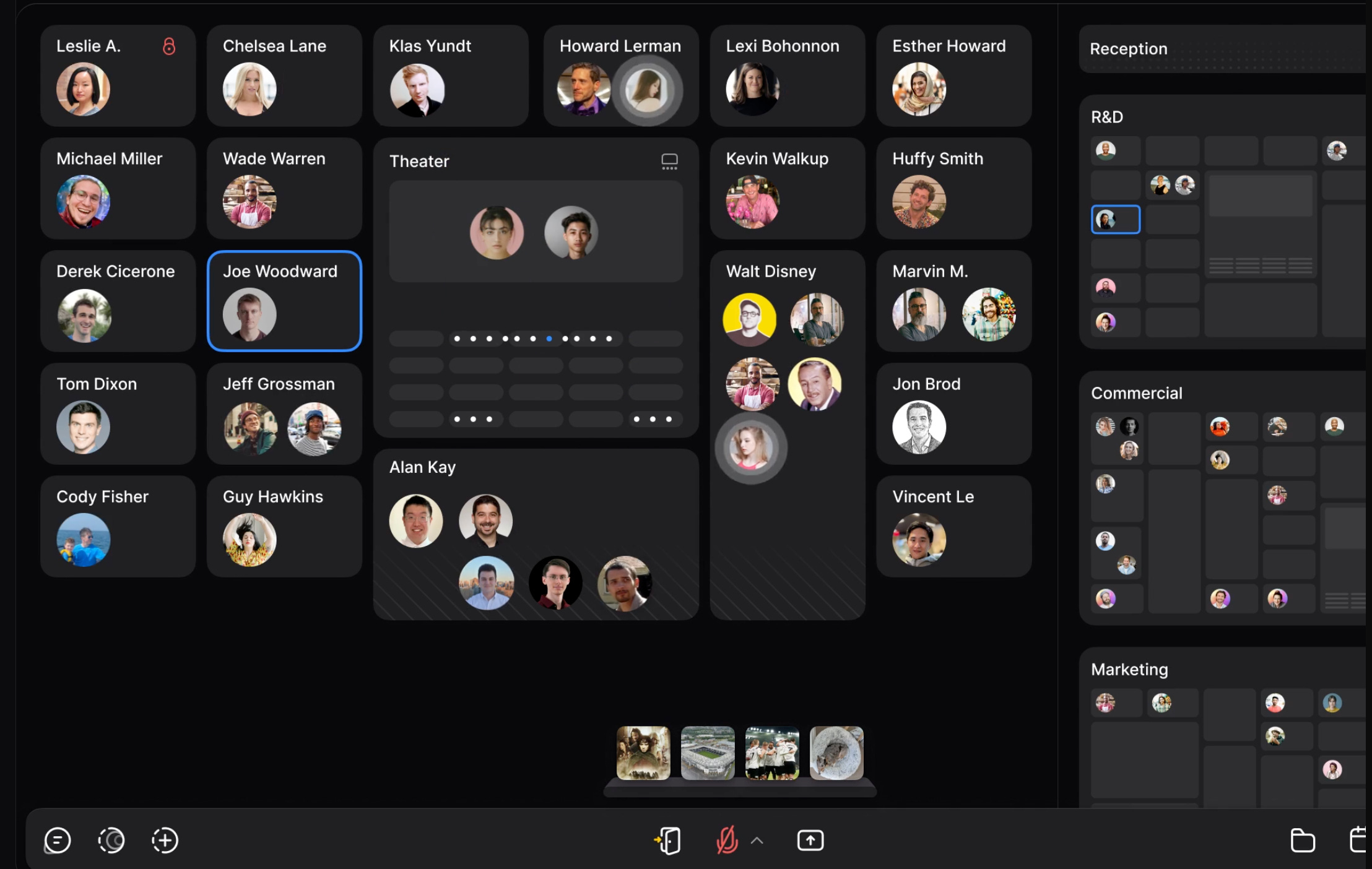
Case Study: A Tale of Four Platforms
Imagine a university seminar taught across these platforms. In Google Meet, a brilliant insight shared in the chat vanishes forever when the call ends. In Zoom, learning is confined to instructor-managed breakout rooms. In Teams, the focus is on organized deliverables in threaded channels. In Roam, the seminar might culminate in students collaboratively designing a virtual museum wing, with each room representing a different theory. The platform's affordances directly shape the nature and outcome of the learning activity.
Implications for Educators: Choosing Our Curriculum
The choice of a learning platform is a declaration of pedagogical values. Research by digital communication scholar Nancy Baym demonstrates how platform features—such as persistence, social cues, and interactivity—directly shape the quality of social interaction and the potential for genuine community formation. A platform with impoverished social cues and no persistence, like Google Meet, is less capable of fostering a strong learning community than a spatially-aware, persistent platform like Roam.
We must move beyond the tyranny of the default. As danah boyd's work implies, students feel the difference between these environments and will adapt their engagement to the context the platform provides. To ignore this is to ignore a fundamental aspect of the learning experience. This uncritical acceptance of technology is precisely the danger Neil Postman identified. When we choose a platform simply because it is embedded, we are allowing technology to define our pedagogy, rather than choosing a technology that serves it.
The research is clear. From McLuhan's macro-theory of media to Gibson's micro-analysis of affordances and the sociological insights of Baym, boyd, and Postman, the conclusion is the same: the tools we use shape how we think, interact, and learn. The question is not "What link is easiest to generate?" but "What environment will best foster the kind of learning we hope to achieve?" By being conscious of the messages our media send, we can make intentional choices that align our tools with our values, ensuring the hidden curriculum is one that empowers, engages, and inspires.
Cited Research:
McLuhan, M. (1964). Understanding Media: The Extensions of Man.
Gibson, J. J. (1979). The Ecological Approach to Visual Perception.
Postman, N. (1992). Technopoly: The Surrender of Culture to Technology.
boyd, d. (2014). It's Complicated: The Social Lives of Networked Teens.
Baym, N. K. (2010). Personal Connections in the Digital Age.