


In my first year of teaching, I had a fifth grader I’ll call Jordan. He was a handful! In fact, my teaching position was only open for me to take the job because of him. Jordan actually single handedly drove his former teacher out of the classroom. Jordan was also dyslexic and spoke African American English (or Language as the field seems to be heading).
I’m sure his earlier teachers never accounted for that. I feel pretty certain that his former teachers didn’t account for his language profile - and this is not me finding fault with them. They saw Jordan’s behavior as the antecedent not as the consequence - the consequence of not being understood and not learning.
Given my background in linguistics and AAE in particular, I heard and saw a student whose language was actually doing something sophisticated. He needed someone to recognize that he was smart and that his language mattered. I taught him with explicit instruction and contrastive analysis, using his grammar as the bridge to the one on the page.
I had gone to Weinland Park Elementary in Columbus, a Direct Instruction school, on purpose. I wanted to teach children who spoke African American English, and my training was in linguistics.
I’ve been thinking about Jordan again while listening to Sold a Story Season 2, which turns from reading to teaching itself and to Direct Instruction in particular. I’m also thinking about it as schools like Alpha hand reading instruction to software. Both conversations involve mostly the same participants and focus on how and what we teach; there is relatively little conversation about language, about the language students bring with them to class and the language the teacher uses and how all of that creates a complexity that needs to be a part of this conversation.
Instead we are arguing about how much time should the school day be? Or how much should I tell the students versus how much should I “let” them discover? Or should AI bots tutor children?
Shudder.
I teach reading and writing to humans who find this quite challenging to learn. I do this because I love the puzzle, the figuring out, and most importantly, the relationship between me and my student. It is not that I have taught them so much; it is that we have learned so much together.
And that first year, boy did I learn a lot; it was Jordan who taught me the subject of this piece. Language matters and the language our students speak must be treated with respect.
Because what Jordan taught me was that a dialect miscue and a dyslexic miscue may sound the same while meaning quite opposite things. When a child reads He is tall as “He tall,” most reading teachers (including reading bots and software) count this as an error - an omission, but a reading teacher trained as a linguist hears this as proof that the child understood the sentence.
What’s happening when a child reads “He tall”
Reading aloud is speech, and speech runs through the speaker’s own grammar. A fluent reader’s eyes move several words ahead of the voice, often to the end of a clause. The reader builds the meaning of that chunk, then says it.
By the time the voice catches up, the exact wording is already fading. Memory research going back to Jacqueline Sachs in 1967 shows that we keep the meaning of a sentence long after we lose its form. So the reader regenerates the words from the meaning, in the grammar they have spoken since they were two.
That’s why the most striking dialect miscues are syntactic. A child reads doesn’t have any as “don’t have no.” A child reads There’s a dog as “It’s a dog.” To do that, the child had to decode every word, parse the clause, and rebuild it. A child who couldn’t read the sentence couldn’t translate it.
This isn’t unique to dialect speakers. Proficient adult readers swap a for the and contract words without noticing. Kenneth Goodman’s miscue research found that meaning-preserving miscues like these increase as readers get better. They’re what comprehension sounds like.
Two miscues that look the same and aren’t
A dialect miscue is a translation; a dyslexic miscue is a breakdown. A dialect miscue happens after the reader has built meaning. A dyslexic omission usually happens before meaning is built, so the sentence breaks instead of being translated.
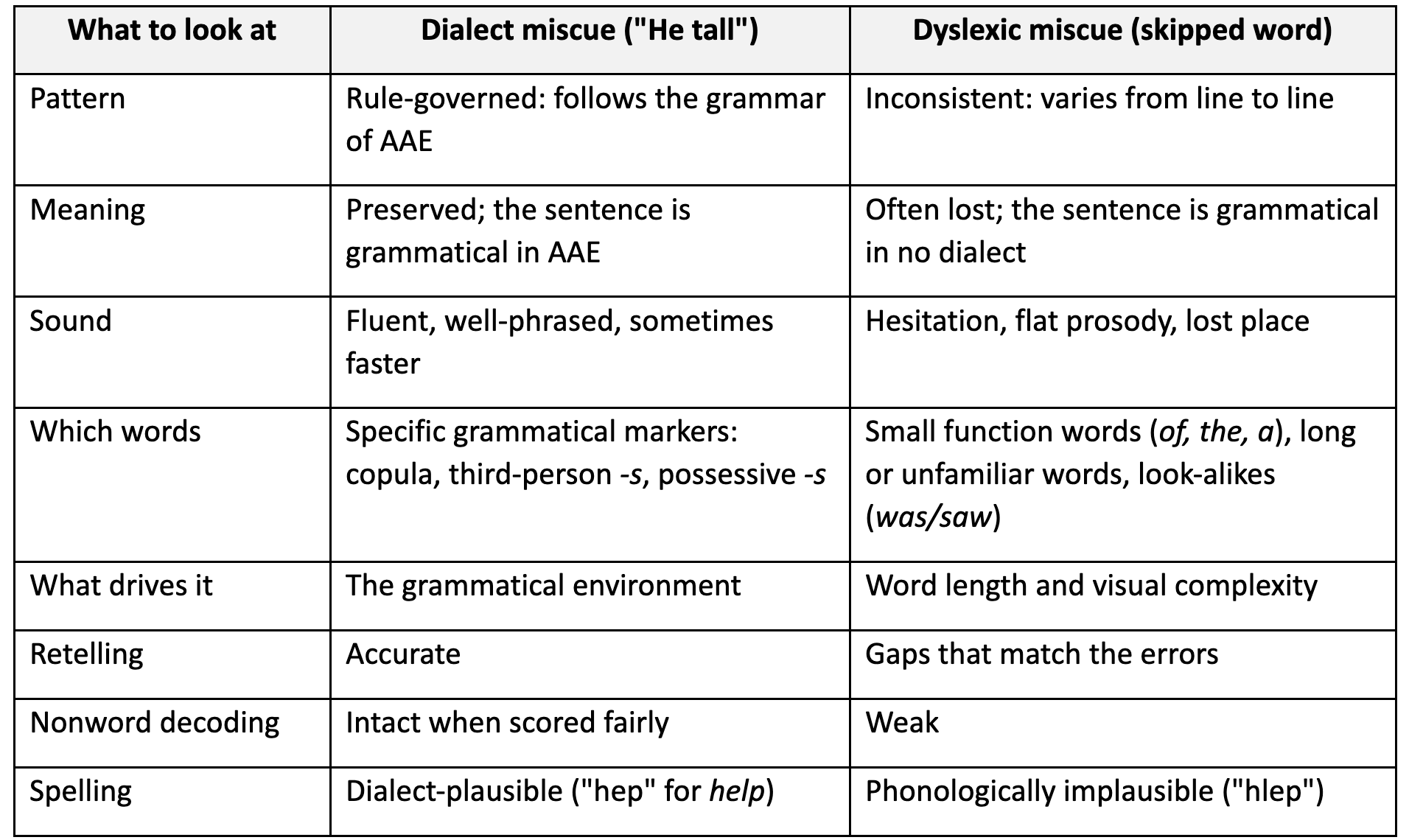
The clearest test comes from William Labov. In AAE, the copula can be dropped only where Standard English could contract it. A child says “He tall,” but never “That’s what he” for That’s what he is. I’m stays. Was stays. If is vanishes everywhere, including the places AAE grammar keeps it, you’re not looking at dialect.
Where to look: the endings AAE keeps
The fastest way to separate the two is to watch the endings that AAE grammar keeps. A missing ending that AAE can drop might be dialect. A missing ending that AAE always keeps is worth a closer look.
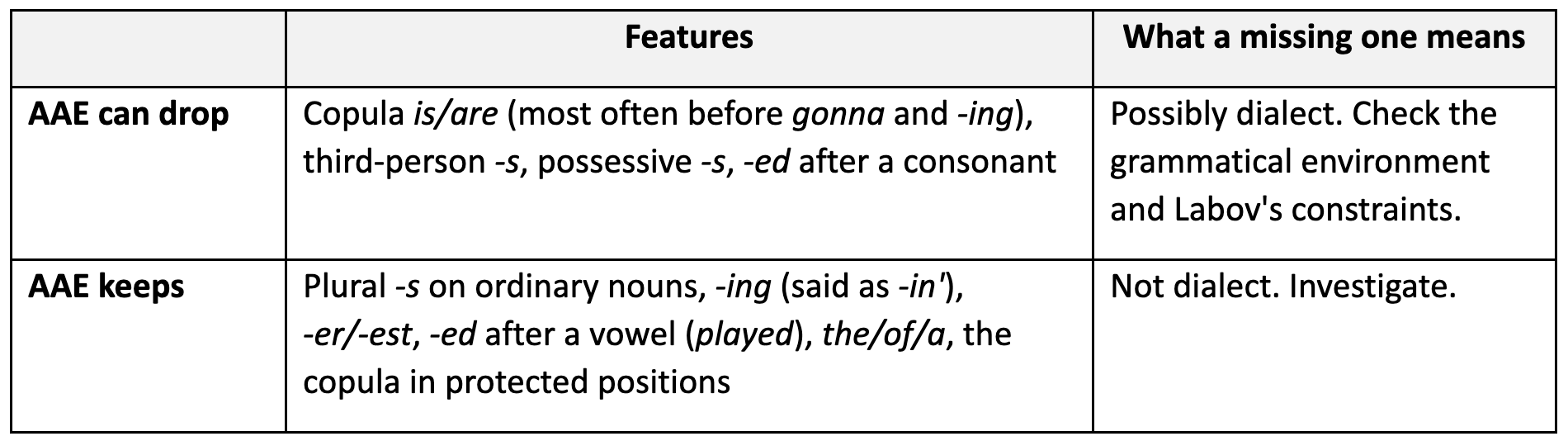
Two of these are especially useful. AAE largely keeps plural -s; it’s mostly absent only with measure words like “five cent.” So a child who regularly drops plurals isn’t showing you dialect. And “runnin’” for running is pronunciation, but “run” for running is an omission because this isn’t a rule AAE follows.
Past-tense -ed is the gray zone. Cluster reduction makes it inaudible in words like passed, so you can’t tell from the sound whether the reader decoded it. Labov’s homograph test settles it: in When I passed by, I read the posters, a reader who understood the past tense says read as “red,” even if passed came out as “pass.”
There’s a sign in the other direction too. A child who reads “they runs” or “I goes” is hypercorrecting - a reader who is managing two grammars at once rather than a reader who can’t decode.
Why this matters now
Sold a Story Season 2 makes a strong case for explicit, systematic teaching, and I agree with explicit, systematic teaching. However, to sell an entire story of reading instruction and not include anything about language, the language kids bring with them to school, the language teachers expect; in short to not involve the linguists in this is quite short sighted.
That omission has history behind it. Direct Instruction grew out of Carl Bereiter and Siegfried Engelmann’s preschool work in the 1960s, which treated Black children’s speech as a deficit, close to an absence of language. Labov’s 1969 essay “The Logic of Nonstandard English” was written partly to answer them. He showed that the speech they dismissed was a full, rule-governed grammar.
The problem shows up today in the correction procedure. A DI script stops the reader, models the word, and has the child reread. That works for decoding precision. But a script has no way to tell “He tall” from a real decoding error, so the child who understood gets the same correction as the child who didn’t. Over time, the child learns to read word by word instead of for meaning, and to hear their own language as wrong.
AI-driven schools could make this worse, faster. Any program that scores oral reading through speech recognition inherits that technology’s blind spots. A 2020 Stanford study in PNAS, with linguist John Rickford among its authors, found an average word error rate of 0.35 for Black speakers versus 0.19 for white speakers across five commercial systems. An AI tutor built on those systems would likely flag dialect features as misreadings, then correct them patiently and endlessly.
The bridge Labov already built
William Labov, who died in December 2024 at 97, had already worked out how to bring the two sides together. He wasn’t against phonics. His 2003 paper “When Ordinary Children Fail to Read” used error analysis to find where African American and Latino children’s decoding broke down, and he backed explicit instruction to fix it. In 1979 he testified for Black students in Ann Arbor whose school had failed to account for their home language.
His position was explicit instruction informed by linguistics. Teach decoding hard and well, and know the child’s grammar well enough to tell a decoding error from a dialect feature. The science-of-reading movement has taken in the first half and lost the second.
In practice, that means a few things for teachers:
Don’t score dialect features as errors on fluency checks, and don’t interrupt oral reading to correct them. This non interruption is SO important. More on this later.
Watch the endings AAE keeps. Missing plurals, -ing, and function words are where real decoding problems show up.
Check comprehension directly with a retelling or a probe like Labov’s read test.
Remember both can be true. A child can speak AAE and have dyslexia. Dialect features never rule dyslexia out.
Teach dialect shifting as its own skill through contrastive analysis, not by correcting a child mid-sentence. Allow the child to embrace fully and completely the beauty of their home language.
Jordan’s mother actually came back to my school the next year to thank me for changing his life - I no longer had Jordan as a student and so her taking the time to come to a school her child no longer attended to tell me that touched me more than she will likely ever know. To teach Jordan to read, I didn’t change his language. I taught him to read with it instead of against it.
When a child reads He is tall as “He tall,” they’re telling us they understood. Our job is to be experts enough to know that when we hear it.
Sources
APM Reports, Sold a Story Season 2 transcripts
Koenecke et al., “Racial disparities in automated speech recognition,” PNAS 117(14), 2020
University of Pennsylvania Almanac, “William Labov, Linguistics”
Labov, W. (1969). “The Logic of Nonstandard English.”
Labov, W. (2003). “When Ordinary Children Fail to Read.” Reading Research Quarterly.
Sachs, J. (1967). “Recognition memory for syntactic and semantic aspects of connected discourse.”
Goodman, K. (1969). “Analysis of Oral Reading Miscues: Applied Psycholinguistics.”
'A dialect miscue is a translation; a dyslexic miscue is a breakdown' cuts through so much of the noise in this debate. When reading software counts every dialect feature as an error, it produces data that misreads kids, and those numbers then drive decisions about intervention and placement.